Garmin inReach has always been useful for the part of the year when you are actually outside and away from cellular coverage. The harder part has been justifying the subscription during the months when the device is sitting in a drawer.
That is why Garmin’s reported change to suspended inReach plans is worth paying attention to. According to recent coverage, Garmin is now offering up to 12 months of SOS access when an inReach subscription is suspended. For seasonal users, that changes the math.
Why this matters
If you use an inReach Mini, inReach Messenger, GPSMAP with inReach, or one of Garmin’s newer inReach-enabled devices, you probably do not use satellite messaging the same way every month.
Here in Nova Scotia, my own pattern is seasonal. There are months when satellite communication makes sense for hiking, paddling, ATV trips, backroad exploring, or travel outside cell coverage. Then there are months when the device may not leave the house.
Until now, that created a familiar choice: keep paying for an active plan just in case, or suspend service and accept that the device is not providing the same emergency safety net.
If Garmin’s new suspended-plan SOS access applies to your account and device, the inReach becomes easier to keep around as a seasonal safety tool.
What a suspended plan is for
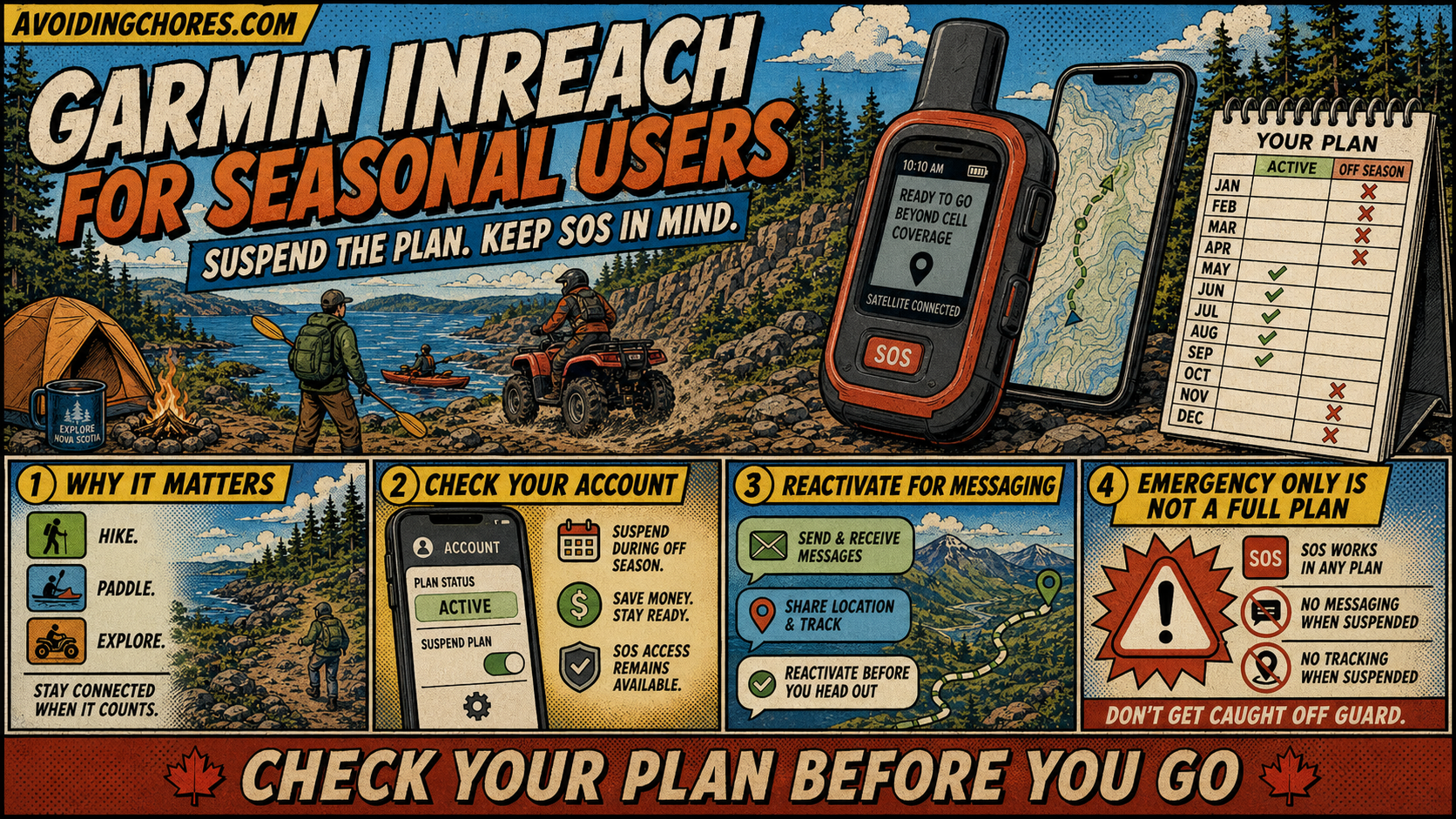
A suspended inReach plan is meant for people who do not need full satellite messaging all year. You can pause regular service during the off-season, then reactivate when you need tracking, messaging, location sharing, weather, or other plan features again.
The important distinction is that a suspended plan is not the same as a fully active plan. You should not assume normal two-way messaging, tracking, presets, weather requests, or MapShare features are available while suspended. Treat the suspended state as emergency-focused unless Garmin shows otherwise in your account.
Who benefits most
This is most useful for seasonal users: hikers who are mostly active from spring to fall, paddlers who only need satellite coverage during trip season, ATV and snowmobile riders with a defined riding window, and travellers who only need inReach service for a few trips per year.
It also makes sense for people who already own the hardware but hesitate to keep a plan active between trips. The upfront cost of an inReach device is one thing; the ongoing subscription is what often makes people compare Garmin against ZOLEO, SPOT, iPhone satellite features, or simply going without.
For Canadian users, especially those crossing through remote areas or spending time in provincial parks, Crown land, logging roads, or backcountry routes, this could be a practical middle ground.
What I would check before relying on it
- Confirm the suspended-plan SOS details inside your own Garmin account.
- Check whether your specific device is eligible.
- Make sure your billing and emergency contact information are current.
- Test the device before a trip, but do not test SOS unless Garmin provides a specific test process.
- Reactivate your plan before any trip where you need normal messaging, tracking, weather, or MapShare.
The last point is the big one. SOS-only access is not a replacement for a regular plan if you want to send messages home, share your location, coordinate a pickup, check weather, or let someone follow your route.
Garmin versus ZOLEO for seasonal users
This also makes the Garmin versus ZOLEO comparison more interesting.
ZOLEO has been strong for people who want simple two-way satellite messaging tied closely to a phone app. Garmin has the advantage if you are already using Garmin GPS devices, watches, Explore, Messenger, or an inReach-compatible handheld.
If Garmin can reduce the pain of the off-season subscription decision, that helps its case with people who only need satellite communication for a few months of the year.
It does not make ZOLEO irrelevant. It just means the subscription comparison is no longer only about the monthly active-plan price. It is also about what happens when you are between trips.
My take
This is a smart move by Garmin. A satellite communicator is the kind of device you buy for the day you hope never happens. But if the cost of keeping it ready feels too high, some people will leave it behind or cancel service entirely.
For anyone who already owns an inReach, this is worth checking before your next trip. For anyone comparing Garmin and ZOLEO, it adds another item to the spreadsheet: what happens during the months you are not actively using the device?
I would still activate a full plan before any serious backcountry trip where communication matters. But for the shoulder season, the off-season, or those gaps between bigger trips, Garmin may have just made inReach ownership easier to justify.
As always, check the current terms in your Garmin account before relying on this in the field.