
Last reviewed: September 12, 2026. EV range, charging availability, Ford software behaviour, charging apps and public charger status can change. Check current charger status before towing with an EV truck.
Towing is one of the biggest questions around the Ford F-150 Lightning.
The truck has plenty of torque. It feels strong. The practical question is different: how much range do you actually lose once a trailer is behind it, and how much planning does that add to a normal Atlantic Canada trip?
This post is meant to be a real-world trailer range test, not a laboratory result. The useful part is not pretending one trip answers every towing question. The useful part is seeing what changed when the Lightning had to pull a trailer on real Nova Scotia roads, with real charging decisions and normal trip planning.
I have already covered a first longer F-150 Lightning road trip in Nova Scotia. That trip helped reduce the normal EV road-trip anxiety. Adding a trailer is the next test because towing changes the equation quickly.
Test Summary
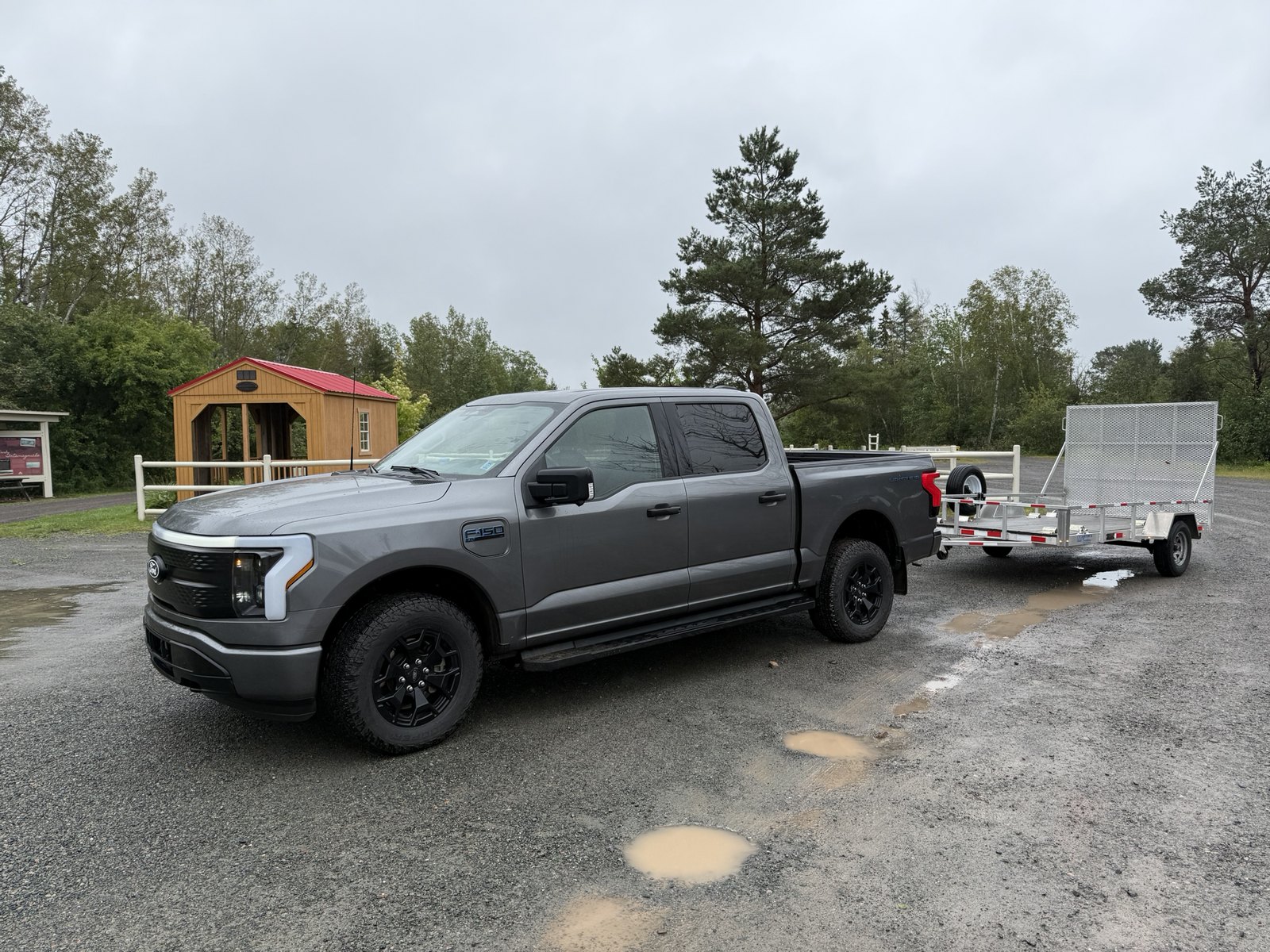
The photo sequence from September 7, 2026 gives this test a useful starting point.
- The truck was a 2025 Ford F-150 Lightning with the standard-range battery.
- The measured outing was about 314 km round trip, based on roughly 157 km each way from the Bedford area to the Tatamagouche area and back.
- The trip started at 87% state of charge and ended with roughly a quarter of the battery remaining. The Labour Day trip notes show a final home arrival of 24% state of charge with 83 km of displayed range remaining.
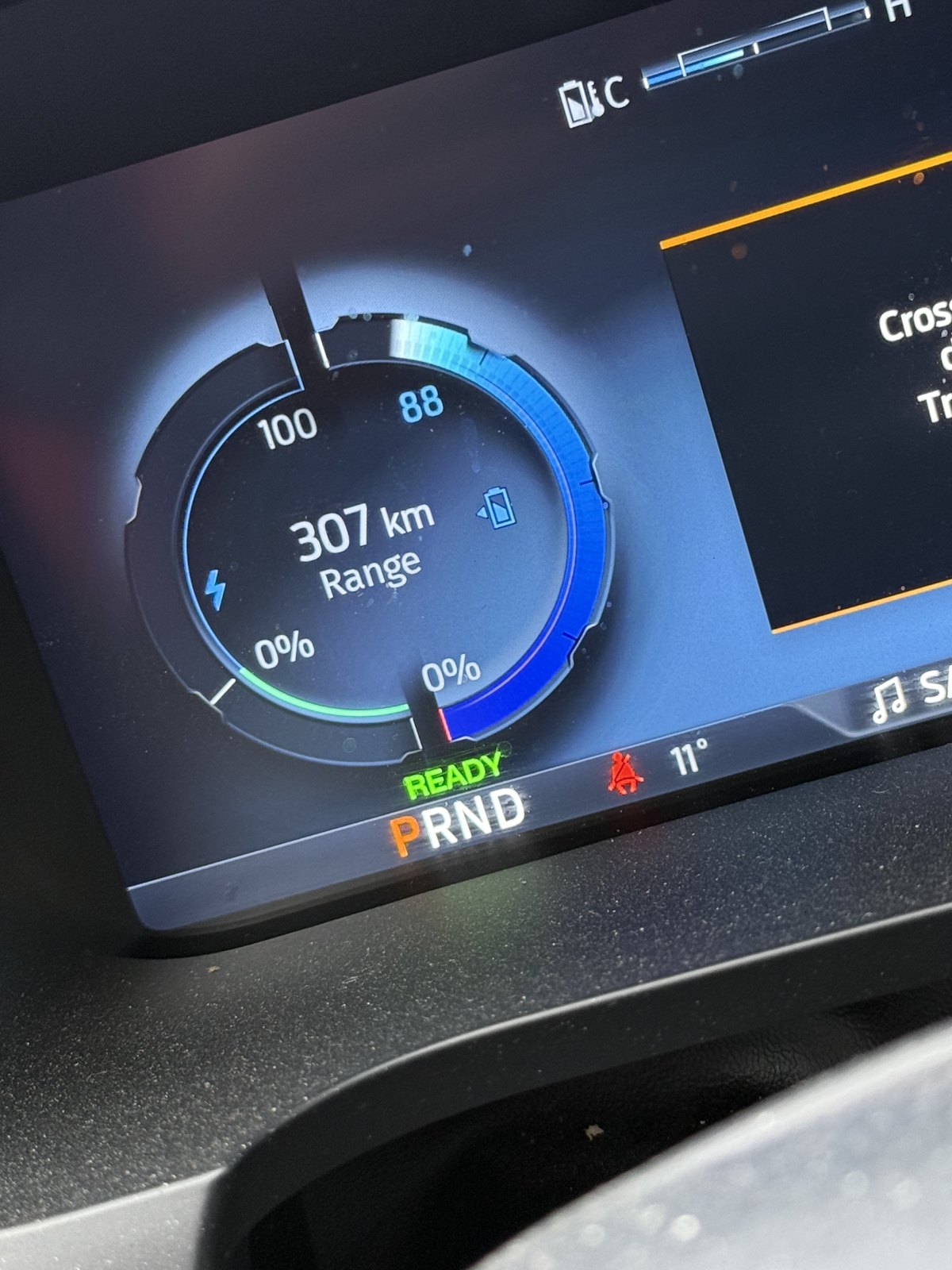
- The truck display showed 88% battery and 307 km of range before the trailer was hooked up and factored into the estimate.
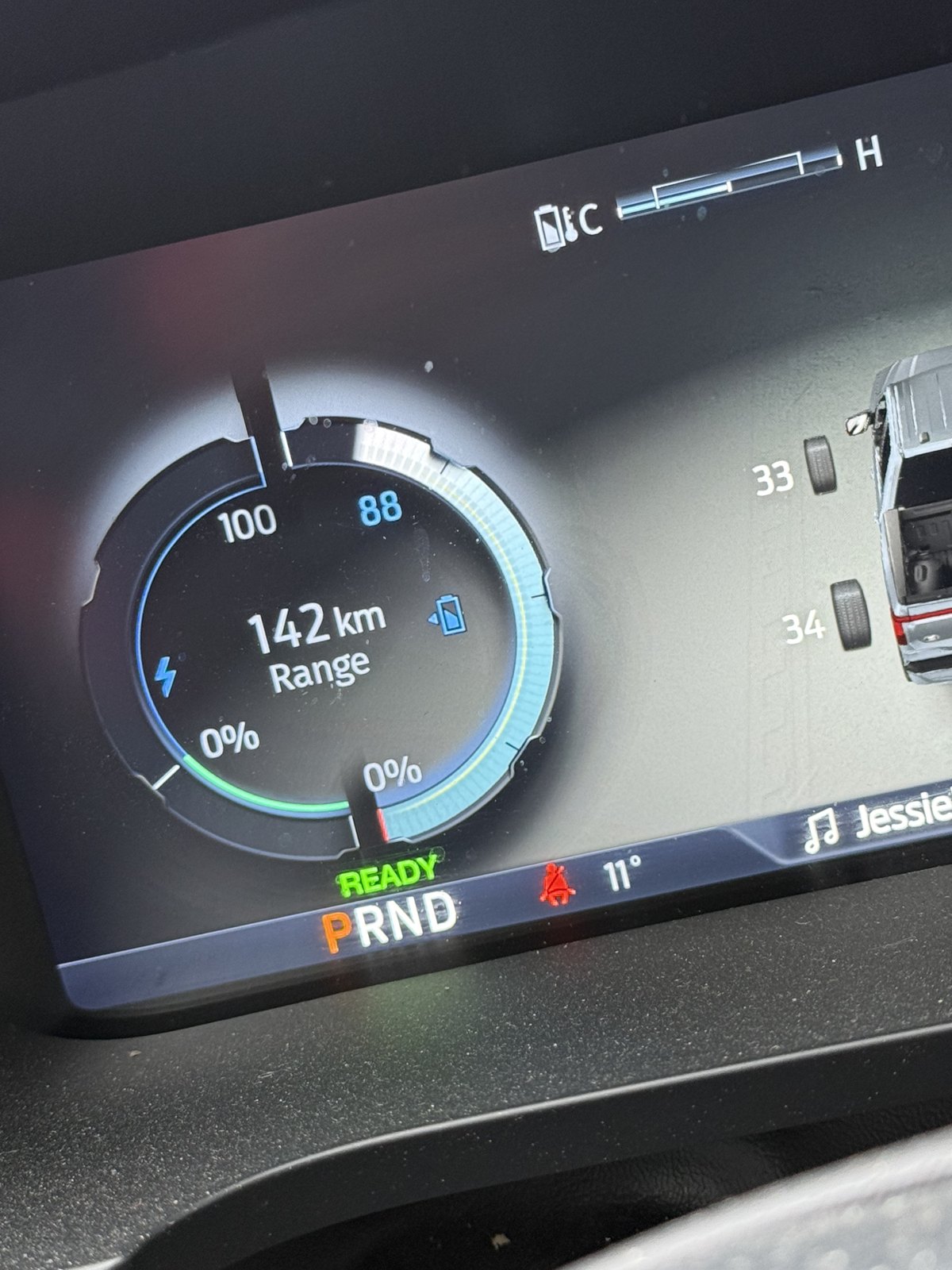
- After hooking up the trailer and entering/selecting the trailer profile inputs in the F-150 Lightning, the display showed 88% battery and 142 km of range with the trailer graphic visible.
- The outside temperature shown on the display was 11 C.
- The trip started from the Bedford area, kept generalized for privacy.
- The outbound route used the faster 100-series highway pattern, mainly Highways 102 and 104.
- The return route was mostly Route 2, which made this a useful comparison between faster highway towing and slower secondary-road towing.
- The trip included several hours of driving, not just a short local trailer errand.
- The route included a Truro-area charging stop and continued to the Tatamagouche area with the open utility trailer still attached.
- Public fast charging added 118.7 kWh over 64 minutes across three stops, at a total cost of $86.95 CAD.
- The slower return route was much more efficient than the faster outbound highway sections, with the best return segments showing 2.2 to 2.3 km/kWh compared with a low of 1.4 km/kWh outbound.
That range adjustment is the headline, but it needs to be explained carefully. The 142 km number is the truck's trailer-profile-adjusted displayed estimate after the trailer was connected and configured, not a measured full-battery towing range result. It is still useful because it shows how quickly the truck can change its planning assumptions once towing is part of the trip.
Why Trailer Range Is Different From Normal EV Range
Ford Canada’s EV range guidance is clear on the basic point: towing affects EV range because a trailer adds weight and aerodynamic drag.
That matches the real-world expectation. The Lightning may have the power to tow comfortably, but range is not only about power. It is about how much energy the truck uses to push the truck, trailer and load through the air, up hills and through changing weather.
With a trailer, the important variables become:
- trailer weight
- trailer shape and height
- speed
- wind
- temperature
- hills and rolling terrain
- tire pressure
- payload in the truck
- charging options along the route
An open utility trailer with a low load is not the same as a tall enclosed trailer or camper. A slow backroad tow is not the same as a windy highway run. That is why this article should present the trip as one practical test, not a universal range number.
The Route And Setup
For privacy, the home end of the route should stay generalized. The useful public route story is that the test started from the Bedford area, headed toward the Tatamagouche area, and returned for a roughly 314 km round trip, based on about 157 km each way.
The route also matters because it was not the same road type in both directions. The outbound drive used the faster 100-series highway pattern, mainly Highways 102 and 104. The return drive was mostly on Route 2, which gave a useful contrast between higher-speed highway towing and slower secondary-road towing.
That makes it a better test than a short local errand. It was several hours of real driving with a trailer behind the truck, and it included a realistic mix of planning questions:
- leaving with a trailer attached
- watching the truck's range estimate adjust
- making sure the first charging stop works with a trailer
- continuing beyond the first charger instead of turning around immediately
- checking how awkward or easy public charging feels while towing
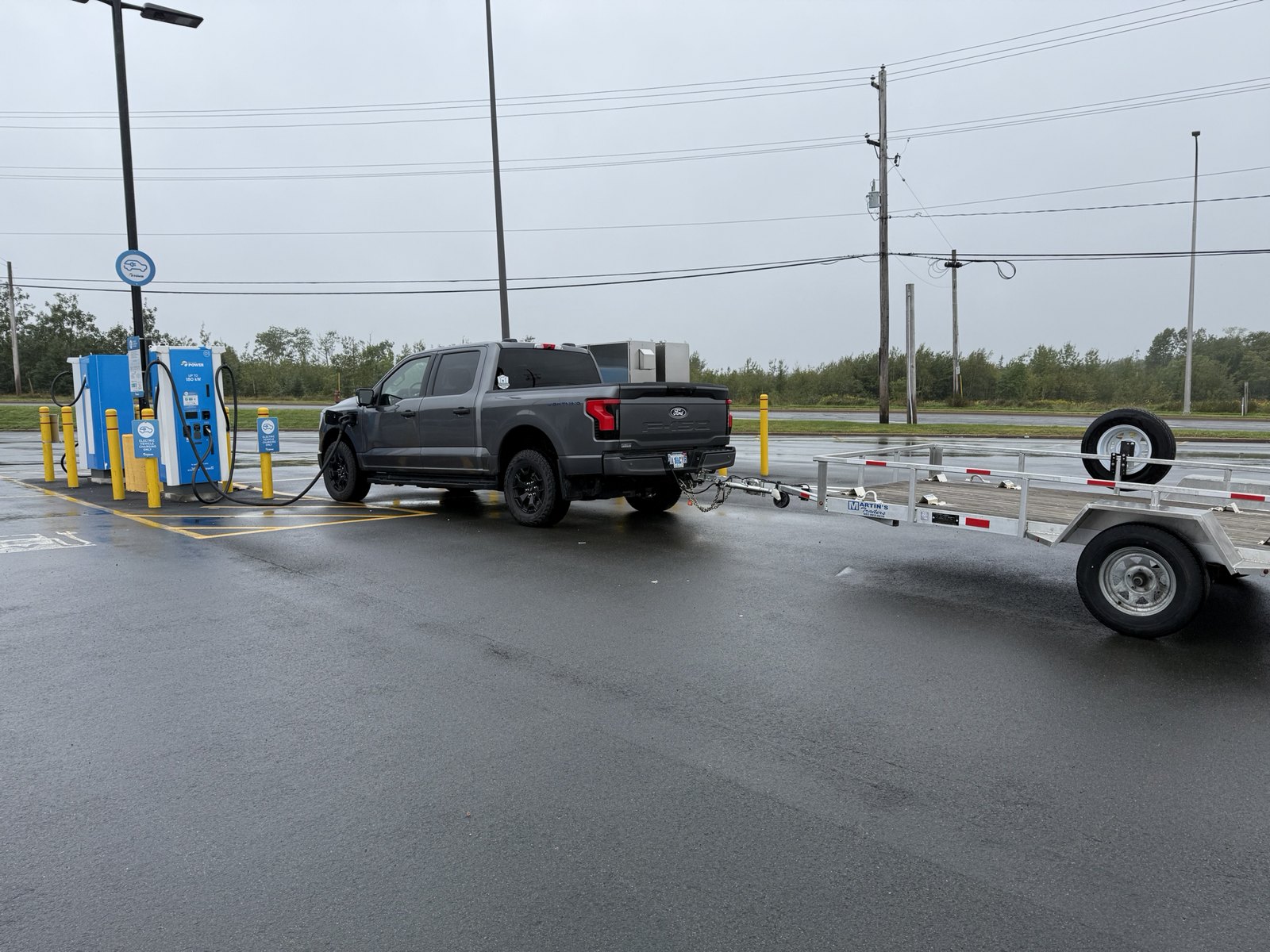
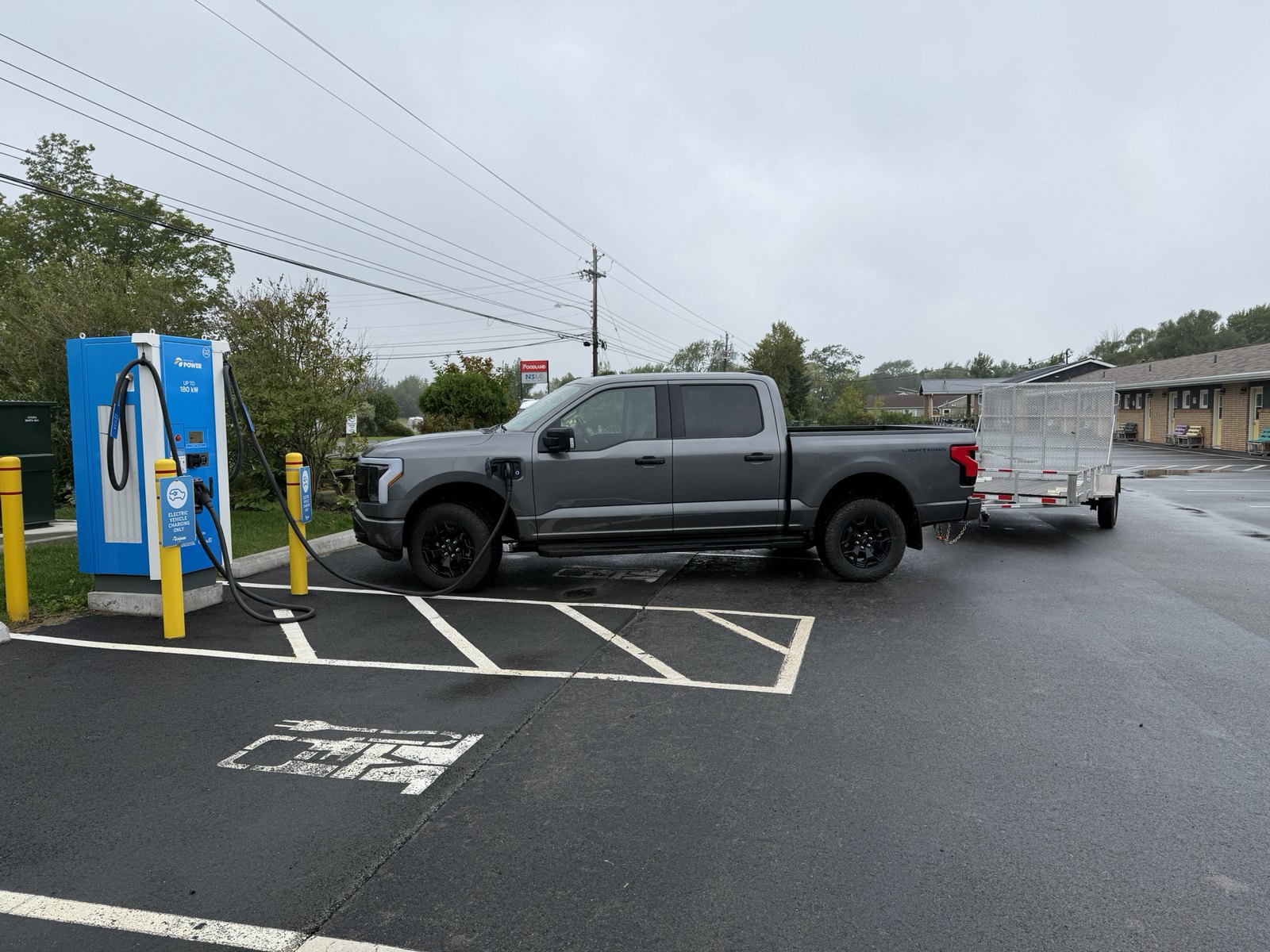
The Truro-area stop matters because charger layout becomes part of the towing experience. A charger can be available and working, but still be awkward if the stalls are tight, blocked or laid out like normal parking spaces.
Trailer And Load
The trailer was an open 6×12 utility trailer with a 6-foot-tall loading ramp, diamond-grill floor and all-aluminium construction. It was fabricated in Prince Edward Island.
That setup matters because trailer shape affects range. This was not an enclosed cargo trailer or camper, but the tall loading ramp still creates aerodynamic drag behind the truck. The trailer was empty for this test, which actually made it a useful baseline. With no load sitting on the deck, the ramp and trailer structure were still exposed to the air, so the test showed the drag penalty before adding cargo weight.
The setup was simple:
- Trailer type: open 6×12 aluminium utility trailer
- Floor/ramp: diamond-grill floor with 6-foot-tall loading ramp
- Load carried: empty trailer
- Approximate empty trailer weight: around 800 lb
- Approximate loaded trailer weight: empty trailer only, around 800 lb plus hitch hardware
- Trailer brake setup: no trailer brake setup
- Hitch setup: standard ball hitch with safety chains
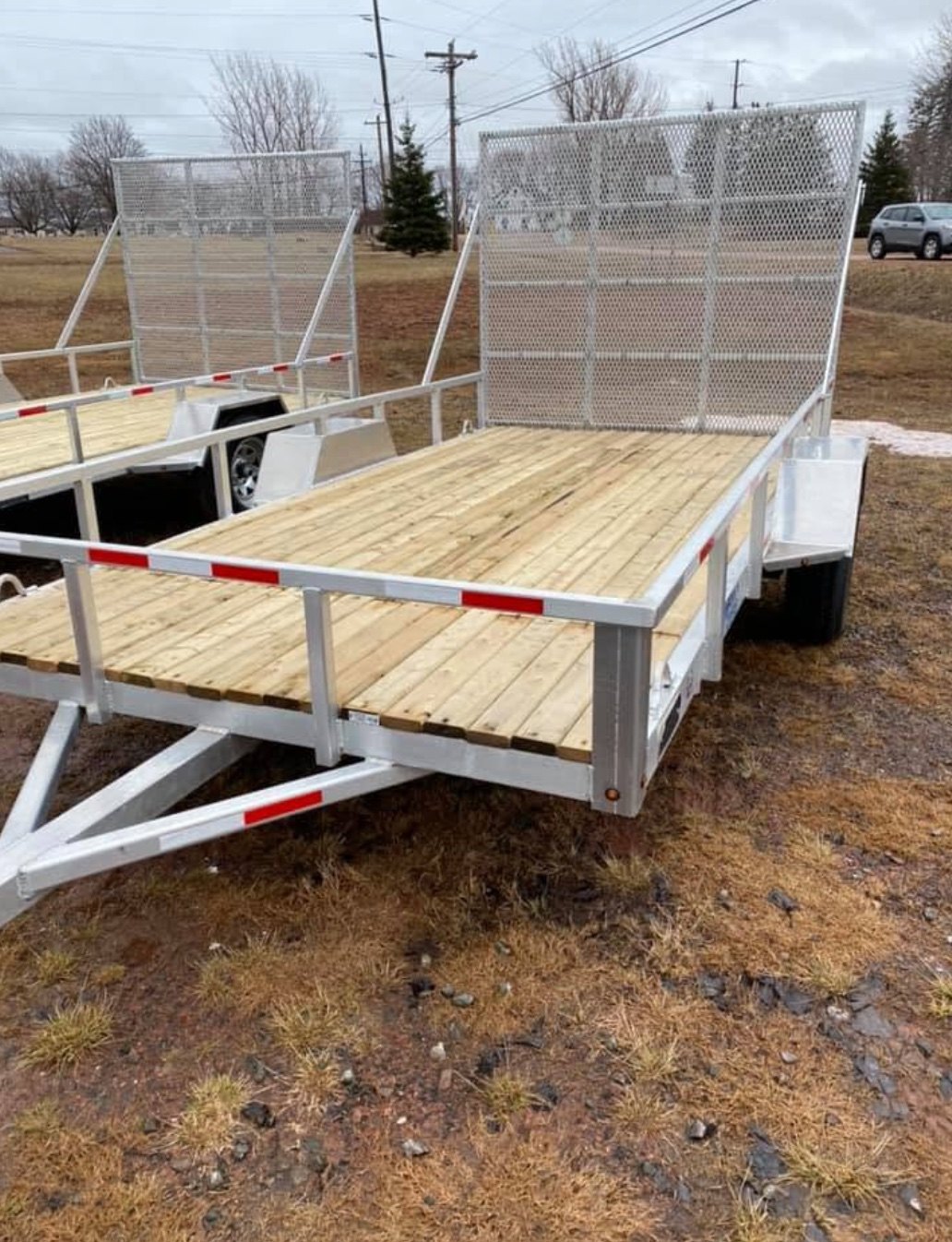
The trailer weight was an estimate, not a certified scale measurement. That is fine for the purpose of this article because the goal was not to test the Lightning's maximum tow rating. It was to understand what a light but draggy open trailer could do to the truck's range estimate and trip planning.
Range Result
The confirmed photo evidence shows a big change in displayed range at the same battery percentage:
- Before trailer estimate/profile: 88% battery, 307 km displayed range.
- With trailer estimate/profile visible: 88% battery, 142 km displayed range.
That is a drop of 165 km in the displayed estimate, or roughly a 54% lower displayed range compared with the first screen.
This does not mean every Lightning towing trip will lose exactly 54% of its range. It means this truck, on this morning, with this trailer setup or trailer profile, was planning much more conservatively once towing was factored in.
The measured trip was about 314 km round trip from the Bedford area to the Tatamagouche area and back, based on about 157 km each way. The full outing started at 87% state of charge and ended with roughly a quarter of the battery remaining. The Labour Day trip notes show a final home arrival of 24% state of charge with 83 km displayed range remaining.
The most useful trip result was the efficiency spread:
| Segment | State Of Charge / Range Notes | Efficiency |
|---|---|---|
| Generalized home area to Elmsdale | 87% departure; about 144 km displayed towing range; Elmsdale stop later corrected to 61% SOC and 100 km displayed range | 1.8 km/kWh |
| Elmsdale to Millbrook | Arrived Millbrook at 23% SOC, 38 km displayed range, with 42 km still to destination | 1.4 km/kWh |
| Fundy/Wentworth area to Tatamagouche | Arrived Tatamagouche at 34% SOC and 54 km displayed range | 1.7 km/kWh |
| Tatamagouche to Masstown | Masstown at 55% SOC and 92 km displayed range | 2.2 km/kWh |
| Masstown to Millbrook | Millbrook at 46% SOC and 75 km displayed range | 2.3 km/kWh |
| Millbrook to generalized home area | Arrived home with roughly a quarter battery remaining and 83 km displayed range per Labour Day notes | 2.3 km/kWh |
That makes route choice one of the biggest findings. The outbound run on the faster highway sections, including Highways 102 and 104, was as low as 1.4 km/kWh. The return on mostly Route 2 reached 2.2 to 2.3 km/kWh. With an empty trailer and tall ramp, speed and drag mattered a lot.
Charging was also part of the test:
| Charging Stop | Time | Energy Added | Cost |
|---|---|---|---|
| Millbrook outbound | 29 min | 50.1 kWh | $39.49 |
| Tatamagouche | 25 min | 46.9 kWh | $32.72 |
| Millbrook return | 10 min | 21.7 kWh | $14.74 |
| Total | 64 min | 118.7 kWh | $86.95 |
At those public fast chargers, the average price paid worked out to about $0.73/kWh. That cost comparison matters because public DC fast charging can make an EV tow trip more expensive than home charging, even when the truck itself is efficient for local use.
The safest reader takeaway is this: when towing, do not plan from the unloaded range estimate. Use the trailer-adjusted estimate, watch consumption after the first stretch of driving, and keep a charging buffer.
Gas F-150 Cost Comparison
For comparison, my gas F-150 would normally be in the 18 to 20 L/100 km range on similar trailer runs when hauling this trailer empty. With a load on the trailer, that number can drop closer to 14 L/100 km.
That sounds backwards at first, but it matches what I have seen with this trailer. Empty, the tall ramp and open trailer create a lot of drag. With a load sitting on the deck, the airflow can be less punishing, even though the trailer is heavier. That is why drag matters so much on longer hauls.
Using the 314 km round trip and a current Nova Scotia regular gasoline reference of about $1.90 to $1.93/L from the Nova Scotia Energy and Regulatory Boards Tribunal gasoline price listing, the rough gas-truck comparison looks like this:
| Truck / Trailer Scenario | Consumption Used | Estimated Fuel Or Charging Cost |
|---|---|---|
| Gas F-150, empty trailer drag baseline | 18 L/100 km | About $108-$109 |
| Gas F-150, empty trailer drag baseline | 20 L/100 km | About $119-$121 |
| Gas F-150, loaded trailer baseline | 14 L/100 km | About $84-$85 |
| F-150 Lightning, this public DC charging trip | 118.7 kWh purchased | $86.95 |
That makes the EV cost on this trip roughly similar to the loaded gas-truck baseline, but lower than what I would expect from the gas truck when the empty trailer is acting like a big drag sail. If most of the charging had been done at home instead of public DC fast chargers, the EV cost would have been lower again.
This is not a perfect lab comparison. The gas numbers are based on my usual real-world F-150 towing observations, and pump prices change. But it does show the same lesson from another angle: with towing, trailer shape and speed can matter as much as weight.
What Changed Once The Trailer Was Attached And Profiled
The most obvious change was not power. It was planning.
The Lightning display went from 307 km of displayed range to 142 km of displayed range at the same 88% battery level after the trailer was hooked up and the trailer profile inputs were used. That immediately changes how you think about the route.
This is an important part of the Lightning towing workflow. The truck is not only guessing from battery percentage. It can use trailer information to make the range estimate more conservative before you leave. That is useful, but it can also be a little sobering when the number changes that much while the battery percentage stays the same.
Instead of asking, "Can I make it there?" the better towing question becomes:
- Can I make it there with enough buffer?
- Did I enter the trailer profile carefully enough for the estimate to be useful?
- Is the trailer empty but still creating a lot of aerodynamic drag?
- Is the next charger usable with a trailer attached?
- Is there a backup charger if the first one is busy, blocked or down?
- Will wind, rain or highway speed push consumption higher?
- Can I turn around or detour without making the battery plan too tight?
That is the mental shift with EV towing. The truck may feel relaxed pulling the trailer, but the route plan needs more margin. The trailer profile is part of that planning because it turns a generic battery estimate into something closer to the towing situation in front of you.
Charging Stops With A Trailer
EV towing is less stressful when charging stops are chosen before leaving.
For Atlantic Canada, I would plan a trailer trip around:
- chargers that are easy to enter and exit with a trailer
- backup chargers within a reasonable distance
- enough battery buffer to skip a blocked or failed charger
- food, washrooms or useful stops while charging
- charger speed and connector type
- whether the charging app shows recent check-ins
Not every charging site is trailer-friendly. Some chargers are placed like normal parking stalls, which can require unhitching or awkward parking if the site is busy. That does not make the trip impossible, but it does change the planning.
Useful reader tip:
Before towing to a public charger, look at recent PlugShare or app photos when available. A charger can be technically working and still be awkward with a trailer.
The Tatamagouche-area photo shows the practical issue well. The truck can charge, but the trailer changes how much space the whole setup needs.
What I Would Do Differently Next Time
This section should be adjusted after Jim reviews the actual trip notes, but the photo sequence already points to a few practical takeaways:
- leave more buffer than an unloaded EV road trip
- start with a high state of charge
- use a trailer profile if available
- keep speed reasonable
- avoid unnecessary tall or drag-heavy loads
- remember that an empty trailer can still create drag if the ramp or profile is tall
- check charger layout, not only charger availability
- keep a backup charger in mind
- treat wind as a real range factor
The main lesson is that towing with the Lightning is not about whether the truck has enough power. It is about whether the route, trailer and charger spacing leave enough margin. For short local towing, that may be easy. For longer Atlantic Canada trips, I would plan the charging stops before leaving and give myself more buffer than I would without a trailer.
Who This Test Helps
This kind of test is useful if you are using an F-150 Lightning for:
- dump runs
- hauling an ATV or side-by-side
- utility trailer errands
- cottage or camp trips
- small equipment hauling
- weekend travel with a trailer
- comparing an EV truck against a gas or hybrid F-150
It is less useful as a blanket answer for heavy towing or large campers. Trailer height and wind drag can change the result dramatically.
Bottom Line
The Ford F-150 Lightning can tow, but towing changes the trip planning.
The truck’s torque and smoothness are not the limiting factor. The planning question is range: how far the trailer lets you go comfortably, where the next charger is, and whether that charger is practical with a trailer attached.
For Atlantic Canada, that means trailer trips need a bit more homework than unloaded EV driving. Confirm the route, check charger status, look at charger layout, and leave more buffer than the truck’s optimistic range estimate might suggest.
Once the confirmed numbers are added, this article should give readers a useful real-world reference point for towing with an F-150 Lightning in our region.