
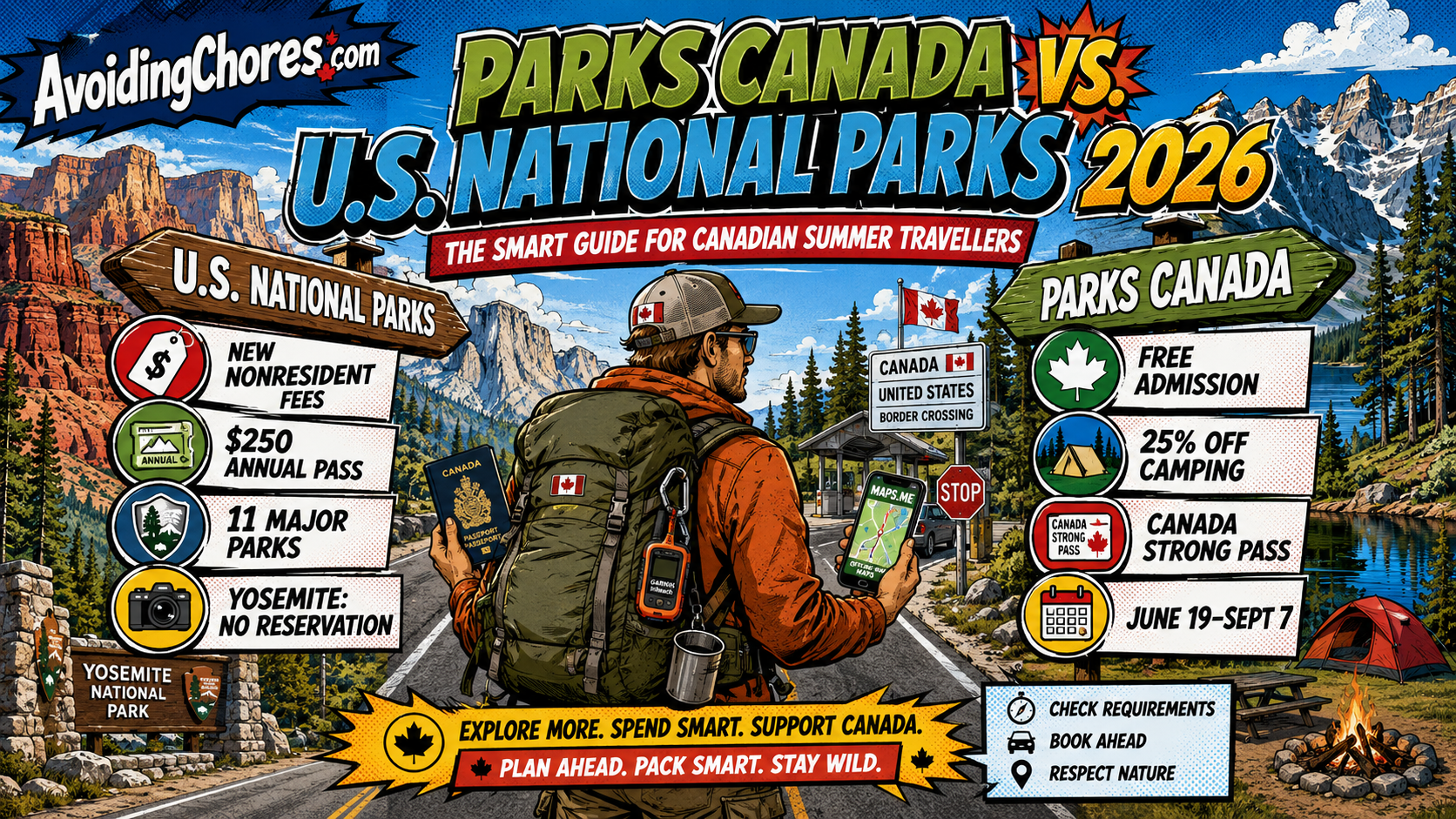
If you’re a Canadian planning a road trip south this summer — maybe Acadia, Yosemite, Yellowstone, Grand Canyon, Glacier, or one of the other big-name U.S. national parks — the planning math changed in 2026.
The short version: some of the busiest U.S. national parks now cost more for non-U.S. residents, the annual pass has a separate nonresident price, and Yosemite is running without a day-use reservation system this year. At the same time, Parks Canada is going the other way for summer 2026 with free admission and discounted camping through the Canada Strong Pass.
None of that should stop you from going, but it does mean you’ll want to check the fee rules before you build the whole trip around a park entrance gate.
This is especially relevant if you’re used to treating national parks on either side of the border the same way — pay at the gate, maybe flash an annual pass, and carry on. That still works in many places, but for Canadians travelling in 2026, the Canada/U.S. comparison is worth looking at before you decide where to spend your vacation budget.
What Changed for Canadian Visitors Going to U.S. Parks in 2026
The big U.S. change is the new National Park Service nonresident fee structure.
Starting in 2026, non-U.S. residents aged 16 and older now pay an extra nonresident fee at 11 of the most visited national parks unless they are covered by an eligible annual pass.
The affected parks are:
- Acadia National Park
- Bryce Canyon National Park
- Everglades National Park
- Glacier National Park
- Grand Canyon National Park
- Grand Teton National Park
- Rocky Mountain National Park
- Sequoia & Kings Canyon National Parks
- Yellowstone National Park
- Yosemite National Park
- Zion National Park
For Canadians, the practical impact is simple: if you are visiting one of those parks without a valid annual pass, you should expect the regular park entrance fee plus an additional nonresident charge for each visitor aged 16 or older.
That can add up quickly if you’re travelling as a family or building a multi-park road trip.
Official details are here:
National Park Service: Nonresident Fees
Parks Canada Is Doing the Opposite This Summer
The timing is interesting because Parks Canada is taking almost the opposite approach for summer 2026.
Through the Canada Strong Pass, Parks Canada is offering free admission to national parks, national historic sites, and national marine conservation areas operated by Parks Canada from June 19 to September 7, 2026. The same summer window also includes a 25% discount on camping and overnight stays operated by Parks Canada.
That does not mean every possible trip cost disappears.
Depending on the site, regular fees can still apply for things like:
- Reservation system fees
- Firewood
- Some permits
- Parking in certain places
- Third-party services
- Transportation services
- Camping or accommodations not operated directly by Parks Canada
But the overall direction is still clear: while the U.S. is adding a premium for international visitors at its most popular parks, Canada is temporarily making its national parks and historic sites cheaper to visit during the core summer season.
For Canadians planning a family trip, that matters.
If your choice is between a cross-border U.S. park loop and a Canadian national park trip, 2026 is the year to actually run the numbers. Free admission and 25% off Parks Canada camping could easily shift the value calculation, especially if you already have big fuel costs or a long drive built into the plan.
Parks Canada details are here:
Parks Canada: Free admission and discounted overnight stays
And the broader Canada Strong Pass page is here:
The Annual Pass Math Is Different Now
The America the Beautiful Annual Pass still exists, but there are now different prices depending on residency.
For U.S. residents, the annual pass remains $80. For nonresidents, the annual pass is now $250.
That sounds steep compared with the old one-price-fits-all pass, but it may still make sense depending on your trip.
If you’re a Canadian visiting one major park for a single day, the pass may not be worth it. But if you’re planning a loop through several of the surcharge parks — for example Grand Teton, Yellowstone, Glacier, and maybe Rocky Mountain — the $250 pass may be cheaper than paying the extra nonresident fee park by park.
The key is to do the math before you leave Canada, not when you’re already sitting in a line at the entrance station.
For official details, check the National Park Service nonresident fee page before your trip:
National Park Service: Nonresident Fees
What If You Bought an Annual Pass Before 2026?
This is one of the better pieces of news.
According to the National Park Service, valid annual passes purchased before January 1, 2026 are still honoured under their original terms for 12 months from the time of purchase.
So if you bought an America the Beautiful pass in late 2025 for a 2026 trip, don’t assume it suddenly became useless. Bring it with you, make sure it hasn’t expired, and carry ID in case staff need to verify the passholder.
That said, don’t rely on second-hand information here. If your trip depends on the pass saving you several hundred dollars, check the official NPS page and the specific park’s fee page before you go.
Yosemite Is Its Own Planning Problem This Year
The other big 2026 change is Yosemite.
Yosemite does not have a day-use or peak-hours reservation system in place for 2026. That means you do not need a separate vehicle reservation to enter the park this summer.
That sounds easier, and in one sense it is. There is one less booking window to chase and one less permit-style document to manage.
The catch is that no reservation system also means more uncertainty once you arrive. Yosemite is already one of the most congested parks in the U.S., and without timed entry controlling the flow of vehicles, you should expect heavy traffic, full parking lots, and long waits during peak periods.
If you’re planning Yosemite this summer, I would treat it less like a casual drive-in stop and more like a logistics exercise:
- Arrive very early
- Avoid weekends if you can
- Have a plan outside Yosemite Valley
- Use shuttles where available
- Pre-purchase passes where possible
- Don’t assume you can roll in late morning and still find convenient parking
Yosemite Mariposa County has a useful 2026 visitor planning page here:
Yosemite Vehicle Reservations Not Required in 2026
And Yosemite Conservancy has a good “know before you go” overview:
Know Before You Go: Yosemite in 2026
Why This Matters More for Canadians
For Canadians, the friction is a bit different than it is for U.S. residents.
You’re not just deciding whether to visit a park. You may be building the park visit into a much larger road trip with border timing, exchange rates, hotel bookings, campground reservations, fuel costs, roaming plans, and maybe a vehicle full of family gear.
A surprise fee at the gate is annoying for anyone. But if you’re already several days into a trip from Nova Scotia, New Brunswick, Quebec, Ontario, or the Prairies, changing plans at the last minute is a lot harder.
That’s why I’d put the 2026 U.S. park changes in the same bucket as checking campground rules, fire restrictions, road closures, and cell coverage. It’s not the fun part of trip planning, but it can make the difference between a smooth day and a very expensive one.
The Parks Canada side of the story also matters here. If your main goal is to camp, hike, paddle, or visit national historic sites, staying in Canada may be unusually good value this summer. But lower admission costs can also mean higher demand, especially at already-popular places like Banff, Jasper, Fundy, Kejimkujik, Cape Breton Highlands, PEI National Park, and Pacific Rim.
Free admission does not guarantee a campsite, a quiet trailhead, or easy parking.
Parks Where Canadians Should Pay Extra Attention
The 11 U.S. surcharge parks are not random obscure sites. They include many of the parks Canadians are most likely to build a major summer trip around.
For Atlantic Canadians, Acadia National Park in Maine is the obvious one. It’s close enough to be realistic for a long weekend or summer road trip, especially if you’re already comfortable crossing into Maine.
For cross-continent trips, Glacier, Yellowstone, Grand Teton, Rocky Mountain, Grand Canyon, Zion, and Yosemite are the kinds of places people plan entire vacations around.
That means the new fee structure probably won’t stop Canadians from going, but it may change how people structure the trip.
Instead of bouncing casually between multiple parks and paying at each gate, it may make more sense to:
- Buy the nonresident annual pass if you’re visiting multiple major U.S. parks
- Spend more time in fewer parks
- Add nearby state parks, national forests, or public lands to the route
- Compare the U.S. trip against a Parks Canada itinerary while the Canada Strong Pass is active
- Consider Canadian national parks if the budget is already tight
- Avoid peak weekends where traffic and lodging prices are working against you
Don’t Forget the Other 2026 Travel Variables
Fees are only part of the story.
This summer, a lot of U.S. and Canadian outdoor travel has the same pattern: more demand, more pressure on infrastructure, more fire restrictions, and more need to check official sources before you go.
If you’re travelling to U.S. parks, I’d check three things before each travel day:
- Park alerts — road closures, trail closures, entrance delays, fire restrictions, shuttle changes
- Fee rules — especially if you’re entering one of the 11 nonresident surcharge parks
- Connectivity — downloaded maps, offline reservations, and a backup communication plan if cell service drops
If you’re staying in Canada and using the Canada Strong Pass, I’d add three more:
- Reservation availability — discounted camping does not help if everything is already booked
- What the discount actually covers — Parks Canada-operated camping is different from nearby private or third-party services
- Local fire restrictions — free admission does not change provincial or park-specific fire rules
That last point is easy to ignore until you need it. A lot of the popular parks have dead zones, overloaded towers, or long stretches where your phone is mostly useful as a camera. If you already use a Garmin inReach, ZOLEO, or another satellite communicator for backcountry trips, it’s worth bringing on a road trip too — not because you expect an emergency, but because plans change quickly when roads, fires, weather, or crowds get involved.
Related Avoiding Chores posts:
- Garmin inReach Messenger vs ZOLEO Feature Comparison
- How to Export the Track Log From Your Garmin inReach
- Baxter State Park – Katahdin
- A Cozy Escape at Moosewood Cabin in Baxter State Park
- Kayaking to Luxie Cove at Kejimkujik National Park
Before You Go
If you’re crossing the border for a U.S. national park this summer, here’s the checklist I’d use:
- Check whether your destination is one of the 11 parks with the 2026 nonresident surcharge
- Compare the cost of paying per park versus buying the $250 nonresident annual pass
- Confirm whether your existing annual pass is still valid
- Pre-purchase passes online where available
- Check the park’s official alerts page the week of your trip and again the day before arrival
- Download offline maps before leaving reliable Wi-Fi
- Keep screenshots or PDFs of reservations, passes, campground bookings, and shuttle details
- Plan for early arrivals at Yosemite and other high-demand parks
- Carry a backup communication option if you’re heading beyond reliable cell coverage
If you’re staying in Canada and using the Canada Strong Pass, I’d also check:
- Whether the site is operated by Parks Canada
- Whether camping or overnight accommodation is actually available
- Whether the 25% discount applies to your specific booking
- Whether reservation fees, parking, firewood, permits, or transportation still apply
- Whether provincial or local fire restrictions affect your plans
- Whether nearby attractions will be busier because admission is free
The bottom line: 2026 is a strange year for park travel. U.S. national parks are still worth visiting, but Canadians now need to factor in new nonresident fees at some of the biggest destinations. Meanwhile, Parks Canada is making national parks and historic sites more affordable through the summer Canada Strong Pass window.
So before you cross the border, run the numbers both ways.
Check the rules, compare the passes, download the maps, and build some flexibility into the route before you leave the driveway.